

how are women in the workplace doing in 2025?
Hot off the presses: LeanIn and McKinsey’s 2025 Women in the Workplace Report dropped yesterday! Just in time for this edition of The Tennie Times, how kind of them.
The 2024 LeanIn and McKinsey report was foundational for me as I was validating the idea behind Tennie. My hypothesis was that young women needed more support early in their career - an assumption based on my personal experience in banking - but that was back in 2019. Did women still need help in 2024?
The answer was overwhelmingly yes.
So while this report last year was a building block for me, the 2025 version also found me at the perfect time. I finished my third semester of business school yesterday, and I’m not going to lie to you, my dear readers. It was a hard semester. I completely overextended myself and prioritized progress over my own well-being. All the while, a few snide remarks and moments of self-doubt left me wondering: what is this all for?
Then I see the 2025 statistics about how women are feeling at work, and I remember why we’re doing this. Because I don’t want anybody feeling how I did at the start of my career, crying in the bathroom on a regular basis, struggling to adjust, and feeling like I had nobody to turn to.
Because young women deserve to feel supported and confident - and that’s not what’s happening.
Let’s get into it.
key findings from leanin and mckinsey’s 2025 women in the workplace report
(you can read the full report here)
-
women are receiving less sponsorship than men early in their careers
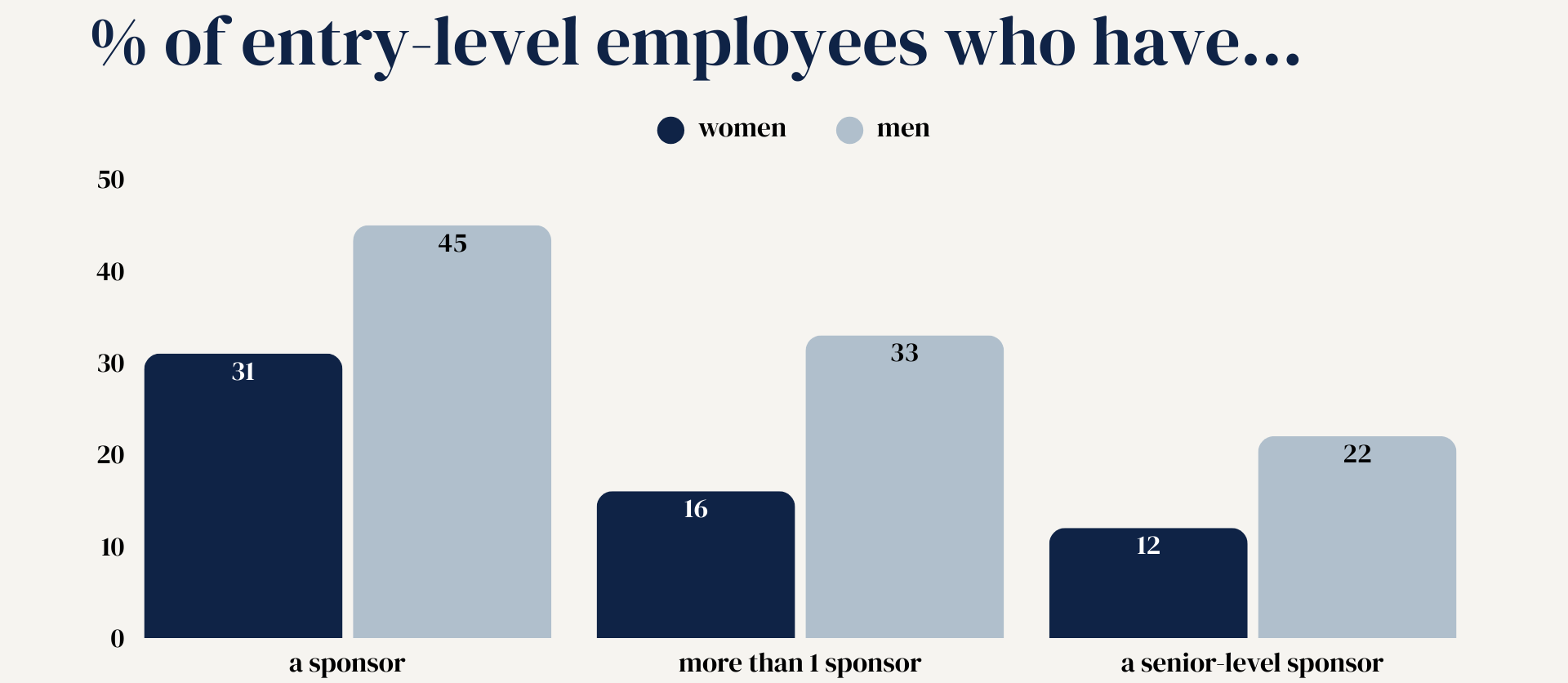
Employees with sponsors are nearly twice as likely to be promoted as employees without, putting entry-level women at a disadvantage from the start. People who have more than 1 sponsor or senior-level sponsorship realize even higher promotion rates, yet only a small portion of women receive this type of support.
Women aren’t just missing out on support; they’re missing out on the kind of high-leverage advocacy that opens doors.
This is the hidden engine of inequality. If women don’t have sponsors early, they don’t get the stretch assignments, visibility, or promotions that build momentum. The “broken rung” starts here - not at the promotion stage, but at the access stage.
And that broken rung is very much still there, with women being promoted from entry-level to manager less than men - 30% of entry-level women have been promoted in the past 2 years, compared to 43% of men - further demonstrating the need for sponsorship.
-
a new trend has emerged: the ambition gap
In an alarming development, for the first time in the 11-year history of this report, women are less likely than men to want a promotion.
To be clear, women are not less motivated and driven to career success. But there’s a disconnect between their mindset and their expectations.
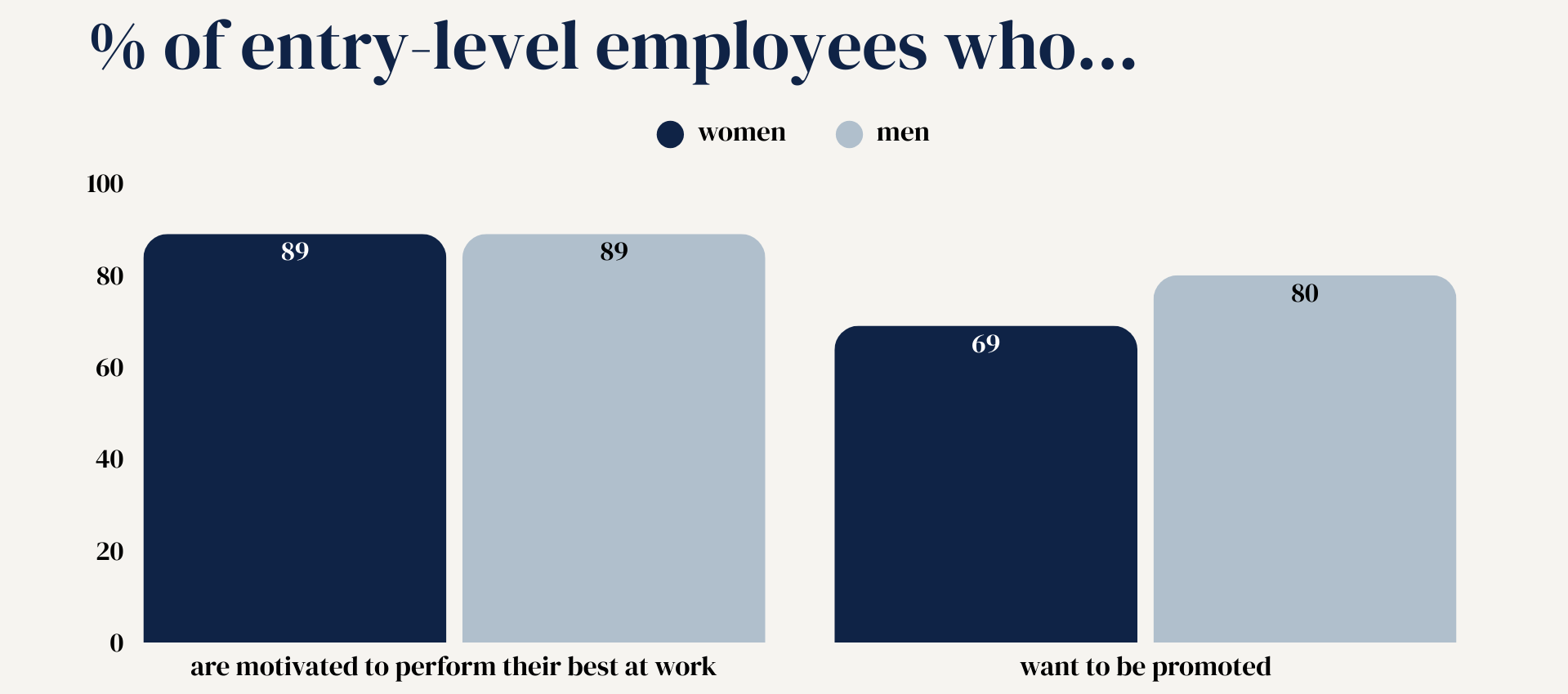
So what’s happening here?
First, career support is strongly linked to an employee’s desire to advance. As we just talked about, women receive less support than men early in their career… by transitive property, we can infer what that means for women’s outlook. I can’t say it enough: supporting women matters!
Second, the report detailed that senior-level women experience higher rates of burnout and perceive a steeper path upward than men. I believe this trickles down to more junior women.
When I’m deciding what career path I want, I look to the people above me in my current role and think: do I want their job? Their life? If the senior-level women I’m observing are miserable, it makes sense I’d be less excited to pursue their career path.
Finally, women continue to bear more of the burden at home. Almost 25% of women who say they are not interested in a promotion say that personal obligations make it harder to take on more work - compared to 15% of comparable men. And with return-to-office mandates, women are increasingly forced to choose between life and career in a way that holds women back.
-
flexibility stigma impacts women, but not men
Let’s talk about that return-to-office, shall we?
For years, the pandemic and consequent remote work arrangement made it easier for people - but let’s face it, mostly women - to manage their personal and professional lives in a way that was more manageable for them. Now that people are going back to the office, however, women are paying the price for working remotely.
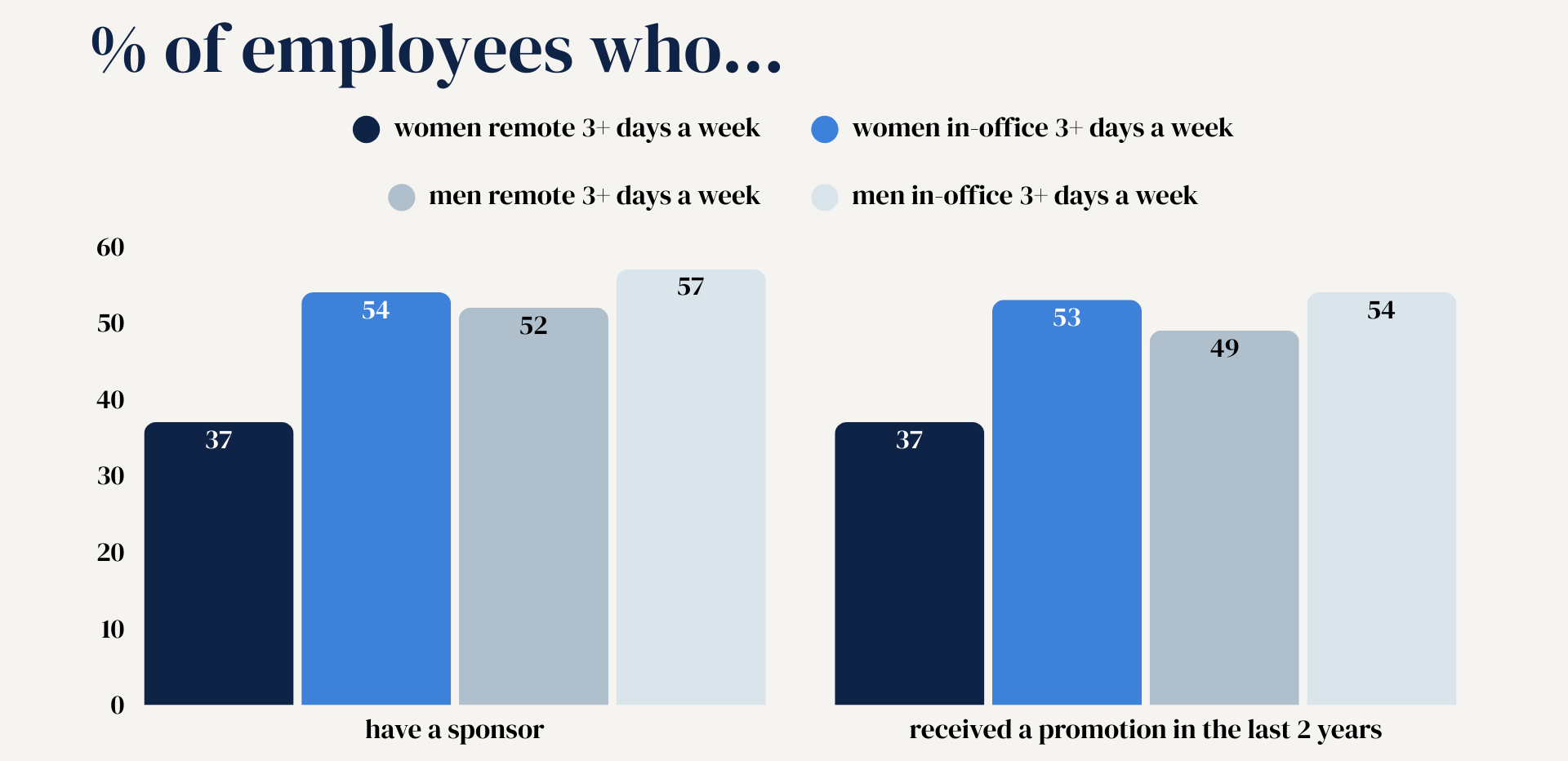
Flexibility stigma is a thing, and LeanIn and McKinsey cite it as one of the biggest factors holding women back at work. In their words, “When women use flexible work arrangements, coworkers often assume they are less engaged and productive, while men’s commitment is taken for granted.”
And this stigma appears to especially impact women early in their careers. Entry-level women are far more likely than other employees to work mostly remotely, and when they do, they are nearly 1.5x less likely to be promoted than women at the same level who work in the office. The same gap doesn’t exist for men.
The topic of return-to-office mandates has been highlighted in the news this year, with general consensus that women are paying the price for return-to-office in a way that’s widening the wage gap and forcing women to consider exiting the workforce altogether.
tennie takeaways
Am I surprised that this wasn’t a particularly progressive year for the advancement of women? Not even a little.
I wish I had better news. The truth is the fight to gender equity is a slow, tedious one, and it takes all of us. Find somebody more junior than you and take some time to get to know them. Be a resource for them. Even if you’re a senior in college, there’s probably a sophomore who could use some support navigating internships, majors, etc.
But also realize your boundaries. Especially as a woman, I know it can feel overwhelming or upsetting to have to be the catalyst for change when you’re already juggling so much. Don’t feel pressured to do too much or be too self-sacrificial. But even one kind comment or acknowledgement of somebody else’s work can go a long way.
Take care of yourself and look out for others, that’s really the best 2 things you can do. In the meantime, Tennie will continue our mission for a more confident, more accepting, more equal future of work.